Storing instructions and boxes: what to keep, flatten, or recycle
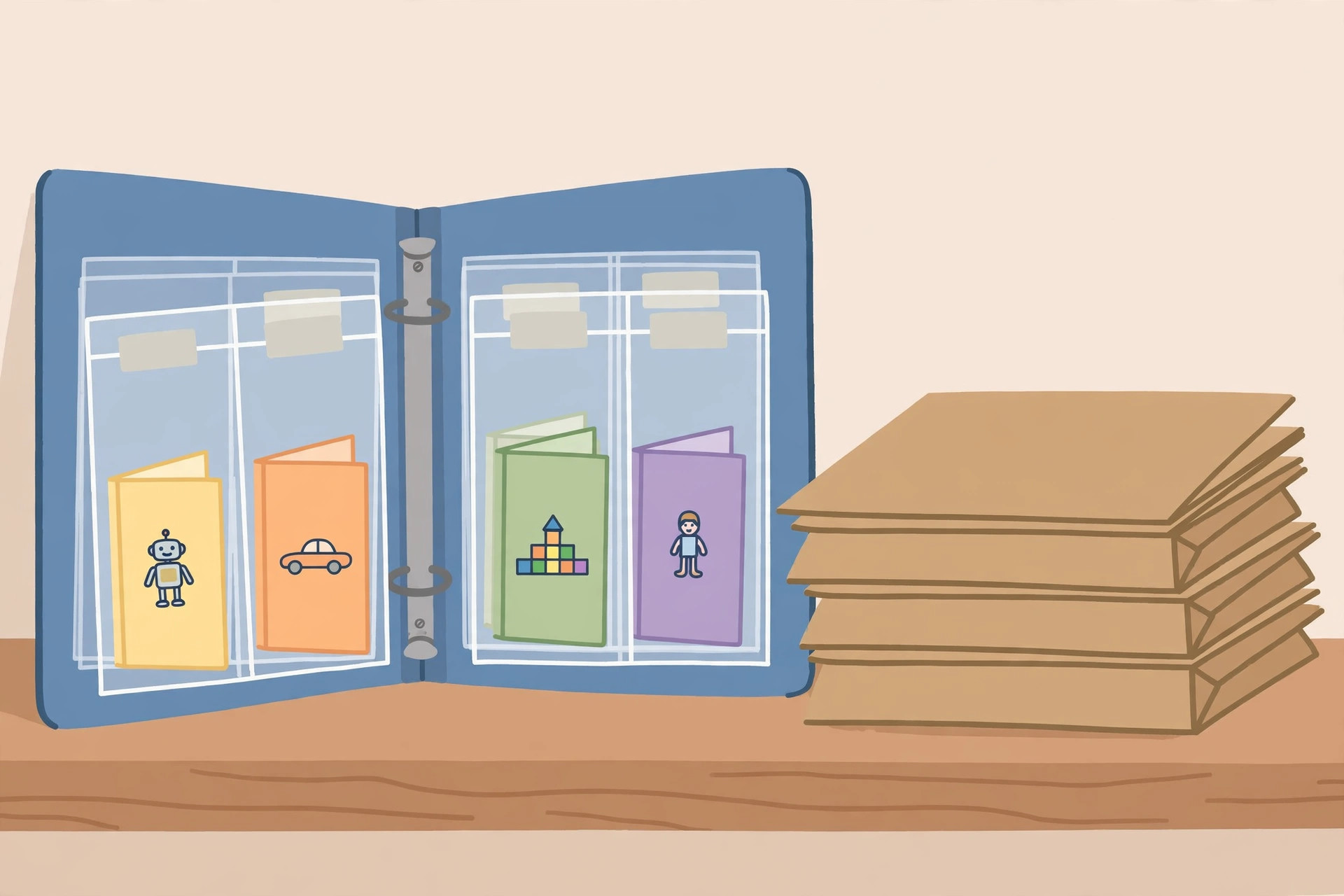
Every set leaves two paper trails: a manual that migrates around the house until it vanishes, and a box that takes up shelf space out of all proportion to its usefulness. Most builders solve each problem separately, or not at all, the manuals end up in a drawer, the boxes in a closet, and both are rediscovered, damaged, when a set is finally rebuilt or sold. This guide treats them as one archive with one procedure: verify the digital backup, file the paper properly, and run every box through a simple keep, flatten, or recycle decision.
First, verify the digital backup
Before deciding any manual can be recycled, confirm its replacement actually exists. The official LEGO Builder app carries thousands of building instructions for sets from 2000 to today, searchable by set, with 3D instructions for supported sets that you can zoom and rotate as you build. The fastest check: scan the QR code on the front cover of the paper manual and the set opens directly in the app. An account saves your digital collection and your building progress, so the backup is also a catalogue of what you own.
The verification matters because it splits your manuals into two honest categories. Sets the app covers have a working digital backup, and their paper copies become a convenience, nice for building away from a screen, no longer the only copy. Sets it does not cover, older manuals are the usual case, have no verified backup, and their paper is the record. File the first category for easy use; protect the second category like it matters, because it does.
Manuals: a filing system that survives being used
| System | How it works | Strength | Weakness |
|---|---|---|---|
| Binder with clasped envelopes | Large three-ring binders; each manual in a plastic envelope closed with a velcro clasp | Manuals stay put when the binder moves; labelled envelopes file by theme or set number | Thick manuals strain small binders; buy envelopes generously sized |
| Binder with sheet protectors | Manuals slipped into plastic sheet protectors in a three-ring binder | Cheapest option; pages flip like a book | Open tops let booklets bunch up and spill when the binder is carried |
| Digital only (Builder app) | No paper kept for app-covered sets; instructions opened by search or QR scan | Zero shelf space; 3D rotate and zoom while building | Nothing to file means nothing to lend; coverage starts at sets from 2000 |
Whichever system you choose, three habits make it work. Sort with a key you will actually use, by theme is the popular choice in household systems, and by set number is the collector's equivalent; either beats the pile. Label every envelope and binder, so the contents are known without opening anything. And store the binder where building happens, on a shelf near the building table, because a manual that lives where it is used is a manual that gets put back.
Note the failure mode hidden in the table: the cheapest system, open sheet protectors, is the one household organisers report abandoning, because top-opening pockets bunch the booklets and dump them out whenever the binder is moved. Clasped envelopes cost a little more and close that failure completely. Collector guidance lands in the same place from the other direction: instructions stored separately from the sets, in binders or folders, organised for easy identification.
Boxes: keep, flatten, or recycle
A box is not sacred and it is not rubbish; it is one component of a complete set, and complete sets are what buyers look for. Original boxes are bought and sold entirely on their own, one marketplace count put over 7,500 original boxes listed on BrickLink at the time of writing, because owners who lost or damaged a box will pay to replace it. What any particular empty box is worth depends on the popularity, age, and rarity of its set, which gives you the decision framework:
| Set tier | Box decision | Reasoning |
|---|---|---|
| Large, licensed, or display sets you may one day sell complete | Flatten and keep | Completeness is part of the set's appeal; a flattened box costs almost no space |
| Everyday sets the household builds and rebuilds | Recycle once the build is confirmed complete | The box's job ended at the build table; space serves the collection better |
| Small sets and polybags | Recycle | Minimal completeness value against years of storage |
| A box already crushed, torn, or water-damaged | Recycle | Condition is the value; a damaged box kept is just stored damage |
Flattening, done right, is reversible: open both ends, collapse the box along its existing folds, and store the flats stacked in a clean, dry, low-traffic spot. Collector guidance is specific on the one detail that matters, keep the folds intact. A box flattened along its factory creases pops back into shape years later; a box crushed flat wherever it gave way does not.
The archive procedure, step by step
1. Gather every manual and box for one batch of sets, a theme or a shelf at a time, not the whole collection at once.
2. Verify each manual's digital backup: search the set in the LEGO Builder app, or scan the QR code on the manual's cover. Mark the set backed up or paper-only on a list as you go.
3. File the manuals: one manual per clasped envelope, envelopes sorted by theme or set number, every envelope labelled, binder shelved beside the building area. Paper-only manuals from step 2 go in first and get the best envelopes.
4. Decide each box using the framework above. Flatten the keepers along their existing folds; recycle the rest the same day, before they drift back into a closet.
5. Store the flats stacked together in a clean, dust-free spot with little foot traffic, and note which sets they belong to on the same list from step 2.
What success looks like: any manual in the house can be in your hand, or open in the app, within a minute of knowing the set's name, every kept box is a flat in one labelled stack, and the list from step 2 tells you exactly which sets are paper-only, so nothing irreplaceable is ever recycled by accident.
One more habit keeps the system alive after setup day: the list from step 2 is a living index, not a one-time worksheet. Add each new set to it when the set is bought, thirty seconds with the app open, rather than in a yearly archaeology session. When a set leaves the collection, strike its line, pull its manual from the binder, and pull its flat from the stack in the same motion, so the archive never claims to hold paper that has already gone. An archive that is slightly out of date is a nuisance; an archive that is confidently wrong is how a paper-only manual ends up recycled by someone who trusted the list. Ten honest lines beat a hundred stale ones.
FAQ
Should you keep every box just in case? Just-in-case is a space decision wearing a value costume. The framework above keeps boxes where completeness plausibly matters and recycles the rest, a flattened keeper costs a centimetre of shelf, an unflattened maybe-box costs a box-sized hole in your storage forever.
Are instructions for old sets available digitally? The Builder app's library covers sets from 2000 to today. Anything older is exactly the paper-only category the verification step exists to catch.
Do manuals belong with their sets? Collector practice says no: instructions stored separately, in binders or folders, survive better and are easier to find than manuals left inside boxes or loose in brick bins.